Is a "Milky White Film" with 79% Transmittance Really Qualified?
Is a "Milky White Film" with 79% Transmittance Really Qualified?
A PE protective film labeled "milky white" has a measured transmittance of 79.73%, yet its haze is only 52.62%. Placed side by side, these figures raise an unavoidable question within the protective film industry: when such an obvious mismatch exists between the "milky white" label and the optical data, is the current evaluation method still sufficient to define the true functionality of a film?
"Visible" Does Not Mean "Clear": A Long-Confused Indicator
In the testing system of PE protective film, transmittance and haze are two parallel optical parameters that are often confused. Transmittance measures how much light passes through the film, while haze measures how much of that light is scattered and deviates from its original direction. For scenarios requiring "quality inspection of sheets without peeling off the film," high-transparency Adhesive Protective Film typically has a transmittance between 88% and 92%, with haze controlled at 8% to 15%. Together, they ensure that "light passes through while the image remains clear." Optical-grade products further tighten this window, with transmittance ≥91% and haze ≤1.5%.
The design logic of milky white PE film is entirely opposite to that of transparent film. The industry's functional descriptions of "milky white" PE protective film are highly consistent: semi-light-blocking, soft and non-reflective, not prone to strong light refraction, good adhesive layer stability, and leaving no residue on high-gloss sheets. Its typical application scenarios are concentrated in high-gloss aluminum profiles, home appliance casings, painted panels, and decorative sheets. The core demand is to reduce the interference of strong light reflection during quality inspection while maintaining a certain degree of obscurity. In other words, the optical performance of a qualified milky white film should be "transmittance actively suppressed and haze significantly increased," rather than maintaining a "milky white" appearance with a moderate level of haze while its transmittance approaches that of a transparent film.
Evaluation Inertia Behind the Data Mismatch
Examining 79.73% transmittance and 52.62% haze within the functional framework of a typical milky white film makes the problem clear. A transmittance of 79.73% is already approaching the lower limit of the range for some transparent films, while a haze of 52.62%, though far higher than that of transparent films, has not yet reached the high-scattering level usually expected of truly "milky white" products. This set of data describes more of a "slightly translucent milky" or "semi-transparent matte" film, rather than a conventional milky white film with soft obscurity as its core value.
The root of this mismatch lies in a long-standing evaluation inertia in the protective film industry: treating transmittance as a universal yardstick for "quality" and haze as a subordinate parameter. In the context of Glass Protective Film and high-transparency Self Adhesive Film, this logic has its rationality—higher transmittance and lower haze indeed mean clearer visual transparency. However, when this logic is indiscriminately applied to functional colored films such as milky white films, blue films, and black-and-white films, the simplified judgment that "high transmittance means a good film" obscures the product's true design intent. The value of a milky white film lies precisely not in allowing as much light as possible to pass through, but in controlling how the light passes through: scattering the light, softening the surface, and preventing high-gloss sheets from producing harsh specular reflections while covered by the film.
Acrylic Sheet Scenario: Function Definition Must Return to Application
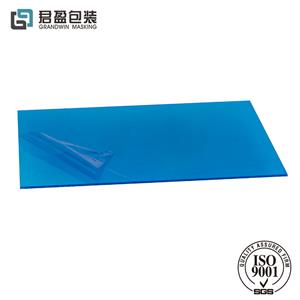
Take Protective Film for Acrylic Sheet as an example; this issue is particularly prominent. The surface of acrylic (PMMA) easily attracts dust and scratches, and has extremely high gloss. During processing, transportation, and use, specialized Self Adhesive Film must not only serve as a physical barrier but also solve the problem of "visual interference." If a protective film with a transmittance close to 80% and moderate haze is applied to such high-gloss acrylic sheets, the refraction of external strong light on the film surface will still be very glaring, hindering processors from judging whether the sheet surface has defects. Therefore, a milky white film truly suitable for high-gloss acrylic sheets often needs its transmittance suppressed to around 50% or even lower to ensure the optical "softening" effect.
Standards System Is Filling in the "Functional Definition" Gap
The adjustment of the evaluation system does not stop at the enterprise level. Clear movements have emerged at the national standard level. GB/T 47066-2026 "Determination of Total Transmittance and Total Reflectance of Plastics," issued in January 2026 and implemented in August, incorporates total reflectance into the measurement framework for the optical performance of plastic films. Meanwhile, the revision plan for "Determination of Transmittance and Haze of Plastics" (20250413-T-606) is underway, meaning the classic pair of indicators—transmittance and haze—is itself undergoing methodological updates. The signals released by these standard actions are consistent: the optical evaluation of protective films is moving from "single transmittance rate" to a "multi-dimensional description of transmission, scattering, and reflection."
For milky white PE protective film, the direct consequence of this shift is that the industry needs to establish quantifiable functional boundaries for "milky white." What range the transmittance should drop to and what level the haze should rise to, in order to simultaneously meet the usage demands of "semi-light-blocking, soft, and non-reflective" and the operability of downstream quality inspection, should be defined by product function rather than following the evaluation yardstick of transparent films. Whether it is Adhesive Protective Film or Protective Film for Acrylic Sheet, the essence of protective film is a functional layer in the manufacturing process. The significance of its optical indicators lies in matching the scenario, not in pursuing absolute values. If a film with 79.73% transmittance is labeled "milky white" and delivered to a high-gloss panel production line, it can neither provide the clarity of a transparent film nor deliver the soft obscurity expected of a milky white film—this is the real question worth asking behind the data mismatch.
As protective films upgrade from production line consumables to functional materials affecting yield and appearance quality, the evaluation logic for optical parameters must also upgrade accordingly. The level of transmittance itself does not constitute a quality judgment. Whether the combination of haze and transmittance points to a clear application intent is the true watershed for industry competition in the next stage.